
Management Systems

ISO 13485: 2016

Medical Devices Quality Management System ISO 13485: 2016 is an internationally recognized Quality Management System standard specifically designed for organizations involved in the Medical Device Industry. It provides requirements for organizations that need to demonstrate their ability to consistently provide medical devices and related services that meet customer and applicable regulatory requirements. ISO confirmed ISO 13485: 2016 as the current edition in 2025.
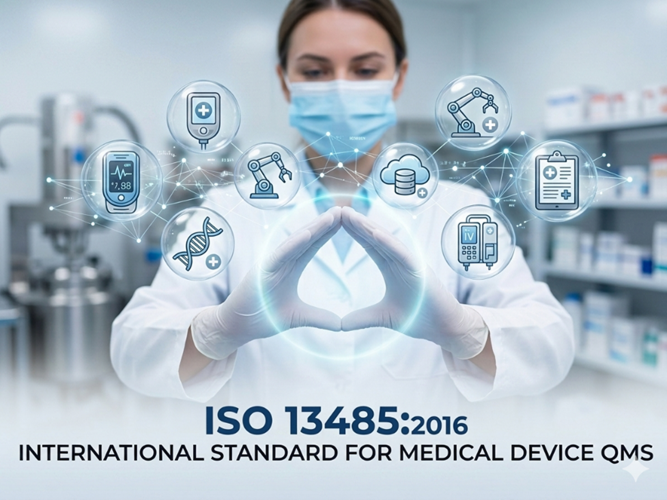
What is ISO 13485: 2016?

ISO 13485: 2016 provides a systematic framework for establishing, implementing, maintaining and continually improving a Medical Device Quality Management System (QMS-MD) .

It places particular emphasis on regulatory compliance, risk management, product safety, process control, traceability, validation and consistent product realization.

Key Requirements

  • Regulatory Compliance – Meeting applicable medical device regulatory and statutory requirements.
  • Risk Management – Identifying and controlling risks throughout the product lifecycle.
  • Product Realization – Controlling design, development, production and delivery processes.
  • Design & Development Controls – Establishing effective controls for medical device design and development.
  • Process Validation – Validating processes where outputs cannot be fully verified by subsequent inspection.
  • Supplier Control – Evaluating and monitoring suppliers and externally provided processes.
  • Traceability – Maintaining appropriate identification and traceability of products and components.
  • Product Safety & Quality – Ensuring products consistently meet specified requirements and intended use.
  • Documentation & Records – Maintaining controlled documented information and records.
  • Corrective Action & Improvement – Addressing nonconformities and improving QMS effectiveness.

Benefits of ISO 13485: 2016

Implementing ISO 13485 can help organizations:

  • Improve medical device quality and consistency
  • Strengthen regulatory compliance
  • Improve product safety and risk management
  • Reduce defects, nonconformities and rework
  • Improve process control and validation
  • Strengthen supplier performance
  • Improve traceability and documentation
  • Increase customer and regulatory confidence
  • Support access to international markets
  • Establish a structured foundation for regulatory approvals
  • Strengthen continual improvement and QMS performance
ISO 13485:2016

Who Should Implement ISO 13485?

ISO 13485 is applicable to organizations involved in:

Medical Device Manufacturing
Medical Device Design & Development
Medical Device Components
In-Vitro Diagnostic Devices
Medical Device Software
Contract Manufacturing
Medical Device Distribution
Installation & Servicing
Sterilization Services
Suppliers to Medical Device Manufacturers

Why Choose Samrat Associates?

Samrat Associates provides ISO 13485 consultancy, implementation, training and certification preparation. Samrat's Principal Consultant is identified on its existing website as a Lead Auditor for ISO 13485: 2016, with experience in Medical Device QMS.

Our support includes:
ISO 13485 Gap Assessment
Medical Device QMS Development
Process Mapping & Documentation
Risk Management Support
Regulatory Compliance Support
Internal Audit Support
Supplier Evaluation & Control
Process Validation Support
Design & Development Process Support
Employee Awareness & Internal Auditor Training
Management Review Support
Corrective Action & Continual Improvement
Certification Audit Preparation

ISO 13485:2016 – Frequently Asked Questions

ISO 13485:2016 is an international standard for a Quality Management System (QMS) specifically designed for medical device organizations. It helps organizations consistently meet customer, statutory and regulatory requirements throughout the medical device lifecycle.

ISO 13485:2016 is applicable to organizations involved in the design, development, production, storage, distribution, installation, servicing, and other activities related to medical devices and associated services.

ISO 13485:2016 helps organizations establish controlled and consistent processes, manage risks, maintain product quality, meet regulatory requirements, and improve customer confidence.

Key requirements include quality management, management responsibility, resource management, product realization, risk management, design and development controls, supplier controls, production controls, monitoring and measurement, corrective action, and continual improvement of the QMS.

The standard provides a structured QMS framework that supports compliance with applicable medical device laws, regulations, and regulatory requirements in the markets where the organization operates.

Implementation generally involves gap assessment, defining the QMS scope, establishing required processes and documented information, implementing risk-based controls, training employees, conducting internal audits, management review, and addressing nonconformities before certification

Implementation time depends on the organization's size, complexity, existing QMS, product range, regulatory requirements, and level of process maturity. A gap assessment can help determine a practical implementation timeline.

ISO 9001 is a general Quality Management System standard applicable across industries, whereas ISO 13485 is specifically focused on medical devices and emphasizes regulatory requirements, risk management, product safety, and controlled processes throughout the product lifecycle.

Yes. ISO 13485:2016 requires organizations to apply risk-based approaches to relevant processes. For medical device organizations, risk management is particularly important for ensuring product safety, effectiveness, and regulatory compliance.

Yes, where applicable to the organization's activities. The standard establishes requirements for planning, inputs, outputs, reviews, verification, validation, design transfer, and control of design and development changes.

Organizations must establish appropriate controls for suppliers and outsourced processes based on their impact on product quality and regulatory requirements. Supplier evaluation, selection, monitoring, and re-evaluation are important elements.

Documented information provides evidence that processes are defined, implemented, controlled, and monitored. The extent of documentation depends on the organization's activities, product risks, and applicable regulatory requirements.

Certification can help organizations improve process consistency, product quality, traceability, risk management, regulatory readiness, supplier control, and customer confidence, while supporting access to regulated markets.

The requirement depends on the country, applicable medical device regulations, product classification, and organization's role in the supply chain. Even where certification is not legally mandatory, it may be an important commercial or regulatory requirement.

Samrat Associates can support organizations with ISO 13485:2016 consultancy, gap assessment, QMS documentation, implementation support, training, internal audit support, and preparation for certification audits, helping organizations develop a practical and effective medical device QMS.