
Management Systems

ISO 14001: 2026 EMS

ISO 14001: 2026 is the latest international standard for EMS (Environmental Management Systems). It provides a structured framework for organizations to manage environmental responsibilities, reduce environmental impacts, meet applicable compliance obligations and continually improve environmental performance.

The Year 2026 edition builds on the established ISO 14001 framework while providing clearer requirements and stronger alignment with current environmental priorities such as climate change, biodiversity, resource efficiency, pollution prevention and environmental performance.

What is ISO 14001: 2026?

ISO 14001: 2026 provides a systematic approach for establishing, implementing, maintaining and continually improving an Environmental Management System in any organization irrespective of their products or services, size, type, and location.

It helps organizations identify environmental aspects and impacts, understand environmental conditions, manage risks and opportunities, meet compliance obligations, improve resource efficiency and integrate environmental considerations into business decisions.

The standard can be implemented by organizations of any size and sector, including manufacturing, engineering, construction, automotive, chemicals, pharmaceuticals, ICT, healthcare, logistics, food, energy and service industries.

ISO 14001:2015 to ISO 14001: 2026 Transition

Organizations currently certified to ISO 14001:2015 should review their existing Environmental Management System against the new 2026 requirements.

ISO states that certified organizations will need to transition to ISO 14001: 2026 within the timeframe established through the applicable certification transition arrangements, typically around three years. Organizations should confirm their specific transition requirements with their certification body.

Key Focus Areas of ISO 14001: 2026

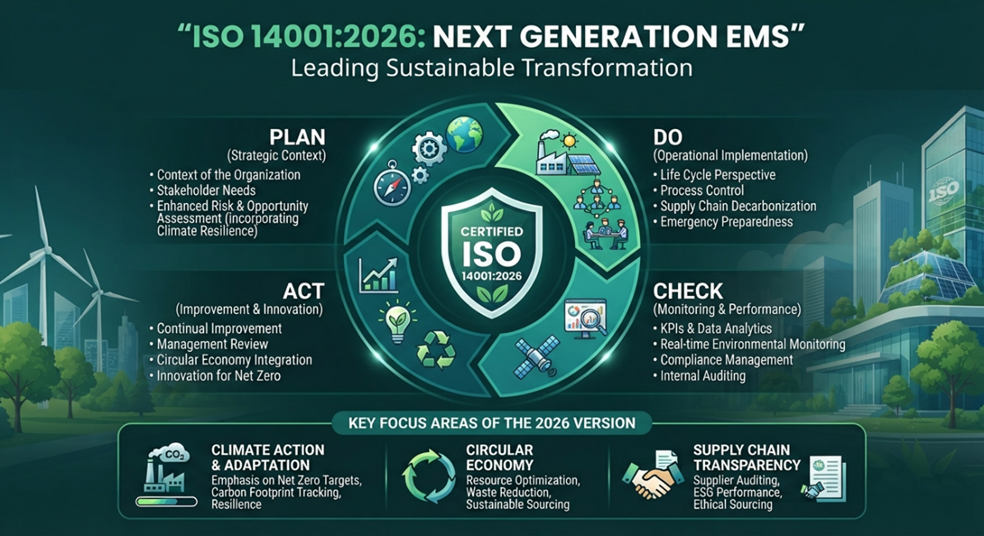
ISO 14001: 2026 focuses on a practical and performance-oriented approach to environmental management system, including:

  • Environmental Context – Understanding environmental conditions and issues that can affect or be affected by the organization, including pollution, climate change, resource availability, biodiversity and ecosystem health.
  • Leadership & Accountability – Strengthening leadership responsibility for environmental performance and integrating environmental considerations into organizational strategy and decision-making.
  • Environmental Aspects & Impacts – Identifying environmental aspects, impacts associated with respective products and processes of the organization. Then Treat each aspect & impact through the E3RP Model (Eliminate, Reduce, Reuse, Recycle, PPE Usage) in a chronological order.
  • Risks & Opportunities – Identifying environmental risks and opportunities and determining appropriate actions to address them.
  • Climate Change & Environmental Conditions – Considering relevant climate-related effects and other changing environmental conditions that may affect organizational activities and objectives.
  • Biodiversity & Resource Efficiency – Increasing consideration of biodiversity, ecosystem health, resource availability, and efficient use of natural resources where relevant.
  • Lifecycle Perspective – Considering environmental impacts across relevant stages of products, services and activities, including processes within the value chain.
  • Compliance Obligations – Identifying, implementing, maintaining and evaluating applicable environmental statutory and regulatory requirements.
  • Environmental Objectives & Performance – Establishing SMART (Specific, Measurable, Achievable, Retrievable, Time-bound) environmental objectives and monitoring performance using appropriate indicators and data.
  • Operational & Value-Chain Controls – Strengthening environmental controls for operations and externally provided processes, products and services.
  • Emergency Preparedness – Preparing In-Side/On-Site & Out-Side/Off-Site Emergency Plans for ensuring the Emergency Preparedness with establishing the Culture of Immediate Response within the organization towards the potential environmental emergencies and incidents.
  • Internal Audit & Management Review – Evaluating EMS effectiveness and Environmental Performance through Establishing appropriate culture of the Regular Internal Audit Programs and Management Review Meetings.
  • Continual Improvement – Identifying the exact Root-Cause for each chance of improvements, then Taking Corrective Action and continually improving environmental performance and the effectiveness of the entire EMS.

The Year 2026 edition places greater emphasis on measurable environmental outcomes rather than processes alone, with stronger leadership accountability and broader consideration of environmental issues across the value chain.

Benefits of ISO 14001: 2026

Implementing an effective Environmental Management System can help organizations:

  • Improve Environmental Performance through systematic identification and control of environmental impacts.
  • Reduce Pollution & Waste through improved operational controls and resource management.
  • Optimum Usage of Resources & Energy Optimization by identifying opportunities for greater efficiency.
  • Improve Regulatory Compliance by systematically managing applicable environmental obligations.
  • Reduce Environmental Risks through proactive identification and management of environmental risks and opportunities.
  • Lower Operating Costs through waste reduction, energy efficiency and better resource utilization.
  • Strengthen Climate & Environmental Resilience by considering relevant climate, resource and environmental conditions.
  • Improve Supplier Performance by extending appropriate environmental expectations across the value chain.
  • Increase Stakeholder Confidence through credible and measurable environmental performance.
  • Improve Employee Awareness by developing environmental responsibilities, competence and participation.
  • Support Sustainable Business Growth by integrating environmental considerations into business decisions.
  • Enhance Market Competitiveness by demonstrating commitment to internationally recognized environmental management practices.

ISO highlights benefits including lower costs through waste reduction and optimized energy and water use, easier regulatory compliance, stronger stakeholder trust, improved supplier performance and access to markets where environmental credentials matter.
ISO 14001:2026 Next Generation EMS

Who Should Implement ISO 14001?

ISO 14001: 2026 can be implemented by organizations of any size and industry, including:

Manufacturing & Engineering
Automotive & Auto Components
Construction & Infrastructure
Chemical & Pharmaceutical Industries
Food & Beverage
Energy & Power
Oil & Gas
Electrical & Electronics
Information Technology
Healthcare
Logistics & Supply Chain
Hotels & Hospitality
Trading & Distribution
Any Service Providers
Any Micro, Small, Medium and Large Enterprises

Why Choose Samrat Associates?

Samrat Associates helps organizations develop practical, process-driven and performance-focused Environmental Management Systems aligned with ISO 14001 requirements. Our approach focuses on integrating environmental management into existing business operations while helping organizations improve environmental performance, regulatory compliance, resource efficiency and continual improvement.

Our support includes:
ISO 14001: 2026 Gap Assessment
Environmental Management System Development
Environmental Aspect & Impact Assessment
Legal & Compliance Obligation Review
Environmental Risk & Opportunity Assessment
Environmental Objectives & KPI Development
EMS Documentation Support
Environmental Performance Monitoring
Implementation Support
Employee Awareness & Internal Auditor Training
Internal Audit Support
Management Review Support
Corrective Action & Continual Improvement
ISO 14001:2015 to ISO 14001: 2026 Transition Support
Certification Audit Preparation

Samrat Associates' existing ISO 14001 services include employee training, documentation, recording and analysis of environmental data, management reviews, monitoring and corrective-action support. The existing page should therefore be substantially updated from its outdated ISO 14001:2004 references to the current ISO 14001: 2026 edition.

Frequently Asked Questions About ISO 14001:2026

ISO 14001:2026 is the latest international standard for Environmental Management Systems (EMS). It provides a structured framework for organizations to manage environmental impacts, meet applicable compliance obligations, improve environmental performance and support continual improvement.

ISO 14001:2026 retains the established EMS framework while providing clearer guidance, easier navigation and stronger emphasis on environmental performance. It gives greater attention to areas such as climate change, biodiversity, resource efficiency, leadership, governance and environmental outcomes.

ISO standards are periodically reviewed to ensure they remain relevant to changing environmental, regulatory, technological and stakeholder expectations. ISO 14001:2026 updates the EMS framework to better reflect current environmental challenges and the need for measurable environmental performance.

ISO 14001:2026 can be implemented by organizations of any size and from any industry, including manufacturing, automotive, construction, engineering, healthcare, IT, food, pharmaceuticals, energy, logistics and service organizations.

Yes. ISO 14001:2026 is suitable for micro, small, medium and large organizations. The EMS can be scaled according to the organization's size, activities, environmental aspects, risks and operational complexity.

ISO 14001:2026 can help organizations improve environmental performance, reduce waste, optimize energy and resource use, strengthen regulatory compliance, manage environmental risks, reduce costs and build stakeholder confidence.

Key focus areas include environmental performance, environmental aspects and impacts, compliance obligations, risks and opportunities, climate change, biodiversity, resource efficiency, pollution prevention, leadership, operational controls, monitoring and continual improvement.

The standard helps organizations identify applicable environmental compliance obligations, determine how these requirements apply to their activities, evaluate fulfilment and integrate compliance considerations into the EMS.

Climate change is incorporated into the environmental context and related considerations of the EMS. Organizations need to consider relevant climate-related issues, risks and opportunities where applicable to their activities and environmental performance.

Top management is expected to demonstrate leadership and commitment, establish strategic direction, provide appropriate resources, assign responsibilities and ensure environmental management is integrated into organizational decision-making and objectives.

An organization can start by conducting a gap assessment, reviewing its environmental context and aspects, identifying compliance obligations, updating relevant processes and documented information, training employees, implementing operational controls, conducting internal audits and completing management review activities.

Documented information depends on the organization's context and EMS. It may include the environmental policy, environmental objectives, environmental aspects and impacts, compliance-related information, operational controls, monitoring and measurement records, internal audit records and management review information.

Organizations certified to ISO 14001:2015 should review their existing EMS against ISO 14001:2026, identify gaps, update relevant processes and documented information, train personnel and verify implementation through activities such as internal audits and management review. ISO states that certified organizations will need to transition within the timeframe established for the transition process, typically around three years.

Implementation time varies according to organization size, operational complexity, number of locations, environmental aspects, existing management practices and level of preparedness. A gap assessment can help establish a realistic implementation plan.

The certification timeline depends on factors such as organizational size, complexity, number of locations, existing EMS maturity, environmental risks and audit readiness. The certification process generally involves implementation, internal audit, management review and assessment by an independent certification body.

Yes. ISO 14001:2026 is designed to integrate effectively with other ISO management system standards, including ISO 9001 for Quality Management Systems and ISO 45001 for Occupational Health and Safety Management Systems. An Integrated Management System (IMS) can reduce duplication and improve management-system efficiency.

An internal audit is a systematic evaluation of the Environmental Management System to determine whether it conforms to applicable requirements and the organization's EMS arrangements and is effectively implemented and maintained.

There is no single fixed frequency that applies to every organization. The organization should establish an appropriate internal audit programme considering the importance of processes, environmental risks, changes, previous audit results and other relevant factors.

The EMS supports continual improvement through environmental objectives, monitoring and measurement, performance evaluation, internal audits, management review, corrective action and evaluation of opportunities for improvement. The 2026 edition places stronger emphasis on demonstrating environmental performance and measurable results.

Samrat Associates can support organizations with ISO 14001:2026 gap assessment, EMS implementation, documentation, awareness and training, internal audit support, compliance-oriented guidance and certification preparation based on the organization's specific requirements.

Prepare Your Organization for ISO 14001: 2026

Whether you are implementing an Environmental Management System for the first time or transitioning from ISO 14001:2015, Samrat Associates can support you with gap assessment, implementation, training, internal audits and certification preparation.

Build a stronger Environmental Management System focused on compliance, efficiency, environmental performance and continual improvement.